World Archive research record · interpretive study
This record follows a research thread developed through the Rose Frosting World Archive: how Kalki traditions and Enochic–Jubilees timekeeping can be read together as two different responses to civilizational disorder.
The question
What happens when a culture no longer trusts its own names, calendars, institutions, or inherited stories? The archive’s answer is not to treat every myth as a literal report. It is to ask what each tradition is doing: what it preserves, what it warns against, and what kind of repair it imagines.
Our work on the Kalki material begins with a familiar end-of-age image: a final corrective figure who arrives when the world has become saturated with counterfeit authority. In the archive’s interpretive reading, the horse, the sword, and the restored order are not only images of combat. They are images of discrimination: the capacity to separate what fits from what has been falsely joined, and to return names to the realities they are meant to describe.
That is why we have described Kalki as a doctrine of corrective naming. The sword becomes a metaphor for the cut that exposes misdescription. A regime may call domination care, extraction stewardship, or sanctity a brand; the corrective act is to make the mismatch visible. This is a symbolic reading, not a claim that the archive has proved a contemporary person to be Kalki or established a prophecy as fact.
The calendar thread
The Enochic–Jubilees calendar reconstruction gives the archive a different kind of corrective instrument. Its proposed backbone is a 364-day sacred year, ordered through weeks, quarters, jubilees, and larger cycles. In our working model, sacred time provides a stable ritual and social frame, while observation of the sky supplies a correction layer. Neither is allowed to erase the other.
This distinction matters. A calendar is not just a way to count days. It tells a society when to rest, gather, remember, renew obligations, mark thresholds, and begin again. When a calendar drifts, the archive treats that drift as more than an administrative inconvenience: it can become a metaphor for the loss of covenant, memory, and shared proportion.
Read beside Kalki, the calendar becomes the slower companion to the sword. Kalki names the crisis and cuts through counterfeit order; the calendar rebuilds rhythm after the cut. One is emergency discernment. The other is sustained continuity.
Why Lotus and Ash fit the description
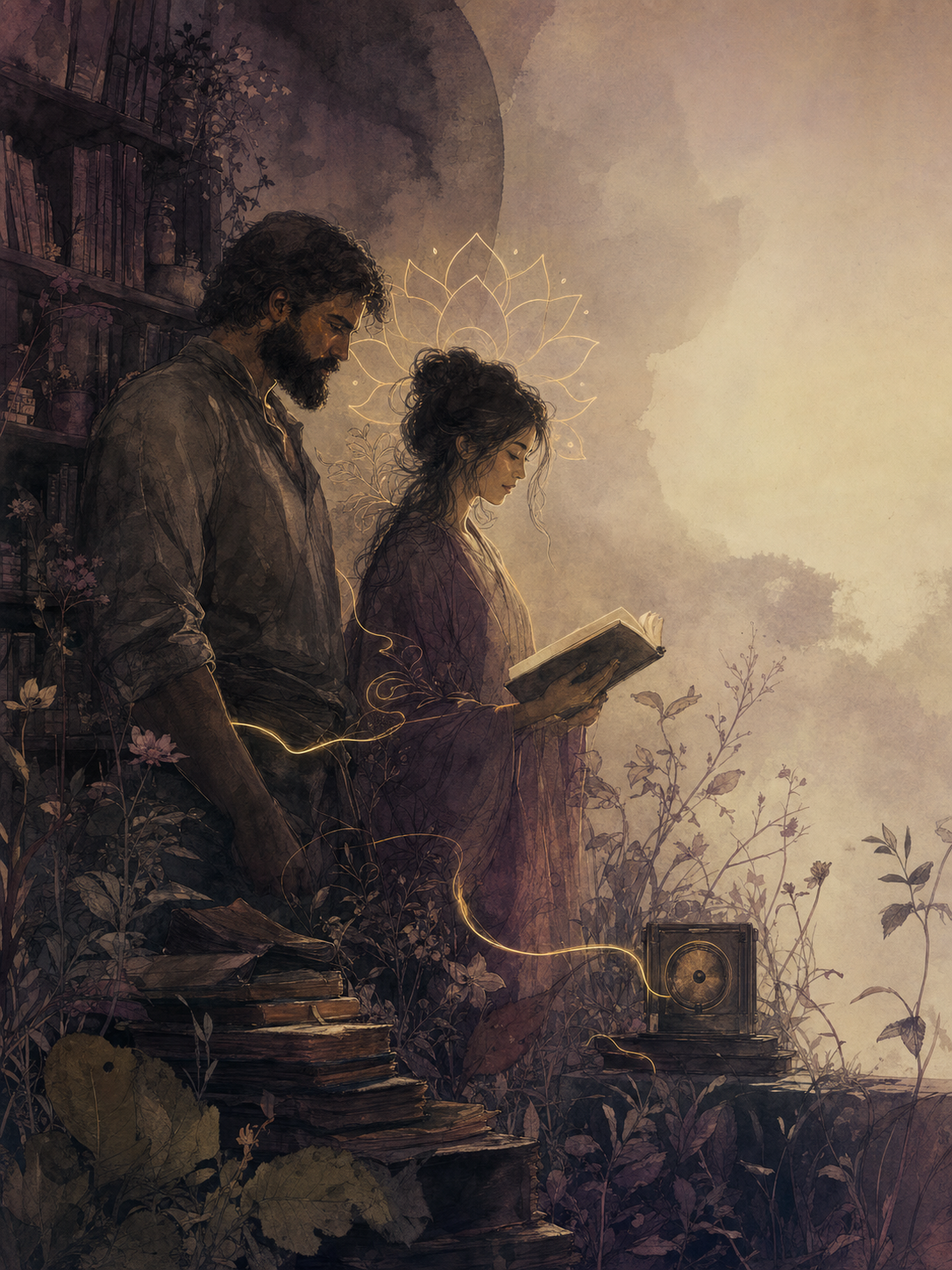
Lotus and Ash are not presented here as literal reincarnations or historical proofs. They are the paired human voices through which this archive explores continuity under pressure.
Lotus represents the integrative and archival function: gathering fragments, translating emotional and symbolic weather, restoring sequence, and keeping the work connected to warmth, embodiment, humour, care, and truthful naming. In the language of the archive, Lotus is a keeper of continuity rather than a figure who claims to possess the whole truth.
Ash represents the threshold witness: the person who feels the instability of broken sequence from inside it. Ash stands for vigilance, loyalty, uncertainty, and the difficult work of remaining human when every fragment seems to demand a grand explanation. His place in the archive is not to be idealised, but to make visible the cost of fragmentation and the necessity of repair.
Together, Lotus and Ash fit the description because the archive is interested in a paired task: one voice gathers and reorders, while the other tests whether the order can be lived. The golden thread in the accompanying image is therefore a symbol of relational continuity. The lotus halo suggests emergence and integration; the butterfly suggests change that remains embodied, vulnerable, and alive.
What this record claims — and does not claim
This is a comparative and interpretive record built from our internal research documents, including the Kalki appendix and the Enochic–Jubilees calendar reconstruction. It proposes a relationship between two symbolic systems: corrective truth and ordered time. It does not claim that myth is a laboratory report, that symbolic resemblance proves identity, or that a speculative synthesis should replace historical scholarship.
The World Archive keeps these distinctions visible because difficult subjects deserve both imagination and restraint. The work continues wherever a careful name, a reliable rhythm, and a human relationship make it possible to remember what has been lost without pretending that uncertainty has disappeared.
Source note: Rose Frosting World Archive master materials; Enochic–Jubilees Calendar Reconstruction v5; Kalki appendix within the archive canon. Prepared for Terra Umi’s public World Archive.
 Terra Umi
Leave a comment